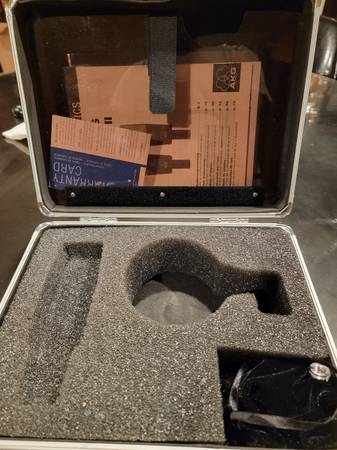
Fresh from recent studio room use
Classic professional microphone
The C414 is probably the best-known microphone that AKG make, alongside the legendary C12. Nevertheless, the C414 has undergone a number of evolutionary changes over its long lifetime, changing shape, adding and discarding transformers, and now, in its latest incarnation, sprouting LEDs!
These C414s are large-diaphragm, multi-pattern capacitor microphones utilising a gold-sputtered diaphragm where only the front side of the diaphragm is coated, the aim being to avoid electrical shorting between the diaphragm and backplate at very high SPLs. The capsule hangs in a newly designed four-point suspension, and even the way the various pattern, pad, and filter options are selected is quite unlike anything AKG have done before. Rather than use slide switches, the mics are now fitted with soft-touch rocker switches that are linked to digital switching circuitry, status LEDs, and a non-volatile memory so that settings are retained when the mic is disconnected from the phantom power source.
Switchable Facilities
The pickup pattern can be switched in five steps to encompass omni, wide cardioid (not available on previous C414 models), cardioid, narrow cardioid, and figure of eight. A tiny system of green LEDs below the switch illuminates whichever option has been selected, and the current selection can be temporarily locked by pressing and holding the rocker selector switch for three seconds. Pressing again for three seconds, or switching off the phantom power, unlocks the setting. The same pattern-selection LED doubles as a clip warning light, and turns red for around one third of a second 2dB prior to clipping. At a recent AKG press event, we were also told that the pattern LEDs are recessed, so that if you can see the LED clearly from the position of the instrument or voice being recorded, the mic is being aimed correctly. This seems like a good idea, except in the event of clipping, where it could be argued that only the person or instrument being miked will be able to see the LED turn red! Maybe all the LEDs should flash red when clipping takes place?
The pad switch now has 6dB, 12dB, and 18dB settings — as with the pattern selection, this works by changing the polarising voltage on the capsule. Because very high impedances are involved around the capsule itself, any changes made using these switches will take a few seconds to become active. The familiar bass-cut switch has also had a face-lift with 40Hz, 80Hz, or 160Hz settings, as well as off. A slope of over 12dB/octave is used for the lower two settings, while the 160Hz setting has a more gentle 6dB/octave characteristic.